Our Faculty Members Presented Gaza-focused Papers at the 7th Middle East Congress

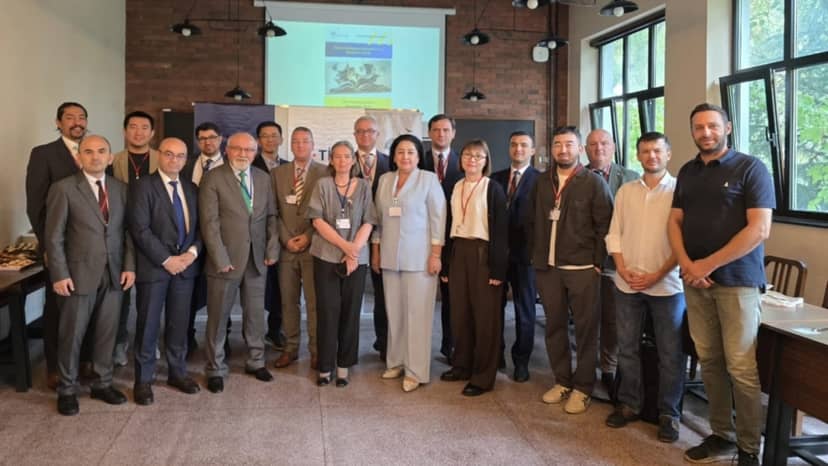
Our faculty members Mustafa Yıldırım, Sümeyye Uyar and Ahmet Yusuf Özdemir attended the 7th Middle East Congress organized by Sakarya University Middle East Institute.
Faculty members of our Department, Mustafa Yıldırım, Sümeyye Uyar, and Ahmet Yusuf Özdemir, presented their papers at the 7th Middle East Congress organized by the Sakarya Middle East Institute. The congress provided a platform for in-depth analysis of the current political and social developments in the Middle East, focusing on regional conflicts and the foreign policy strategies of states.
Foreign Policy Strategies of States in Ukraine and Gaza
Mustafa Yıldırım and Sümeyye Uyar presented their paper titled "The Two-Level Game of State Responses to the Gaza Crisis: How State Leaders Navigate Palestinian Solidarity and Refugee Resistance" in the panel "Nonstate Actors and Conflict & Resolution in the Middle East." In their paper, they examined how states have responded to the Gaza Crisis, analyzing the alignment of state leaders with international norms (particularly the Responsibility to Protect - R2P) and local political constraints. Their study also analyzed state foreign policy strategies through the lens of the "two-level game" theory.
Yıldırım and Uyar argued that states often use rhetorical discourses in relation to humanitarian interventions, which sometimes take the form of low-cost alignment with international norms, rather than high-cost interventions. They also highlighted the differing strategic interests in the responses to the Ukraine Crisis and the Gaza Crisis, noting that responses to Ukraine were more aligned with humanitarian and strategic goals, whereas those to Gaza were primarily rhetorical.
Dynamics of Cooperation among Palestinian Resistance Groups
Assist. Prof. Dr. Ahmet Yusuf Özdemir also presented his paper titled “The Dynamics of Non-State Armed Groups' Co-operation in the Middle East: The Case of the Joint Operations Room of Palestinian Resistance Groups”. In this paper, Dr. Özdemir examined the dynamics of Palestinian resistance groups' cooperation. Using a unique dataset and methodology, he analyzed in detail the strategic cooperation of Palestinian resistance groups, how they coordinate with each other, and how they combine their operational objectives over the period 2007-2023.
While designing this study, Özdemir analyzed the posts of the “Joint Operations Room” group, which consists of 12 different groups operating in Gaza, on the messaging program Telegram, which has not been analyzed by researchers before. This study reveals how non-state armed actors in the Middle East in general and in the Palestinian Gaza Strip in particular, from different ideological backgrounds, unify their discourse and actions against a common enemy (Israel) and goal (breaking the blockade).
The 7th Middle East Congress, where these papers contributed to a better understanding of the conflicts in the Middle East and the reactions of states to humanitarian interventions, offered participants the opportunity to examine the dynamics in the region in depth.
Photos


Related Content

Prof. İsmail Numan Telci Visits Pakistan upon the Invitation of the Ministry of Foreign Affairs
“War in the Gulf and Iran: From Regional Conflict to Global Crisis” Panel Held

War in the Gulf and the Crisis of Regional Order Were Discussed at the First Panel Organized by Gulf Studies and Global Policies Center

Political Science and International Relations Department Shows Strong Student Presence at Midwest Conference

Assist. Prof. Stephen Siu Kay On Presented a Paper at the Marmara Political Science Congress

Assist. Prof. Sümeyye Kaya Uyar and Research Assistant Mustafa Yıldırım Presented Their Papers at the BISA-ISA Joint Workshops

Assoc. Prof. İdlir Lika Receives Second Prize in the 2021 Richard Gillispie Mediterranean Prize
Prof. Yaşar Sarı Participated in the Opening Program of the 'Center for Turkic Studies' in Budapest